On Self Preservation
One might imagine the self as a sort of blubber entity in outer space representing a planet. Any other being we interact with might then be another blubber entity, and whenever we enter one another’s proximity and interact, it’s like the never ending moulding of the blubber we are changes in various directions. We are influenced by the other’s being.
We might view the outer edges of our blubber to be a graph with a sine function where the convex and concave elements are deeper and/or stabler depending on both our own characteristics (e.g. emotional stability and big five personality traits) and the extent of other people’s poking of our being; which obviously we react to differently depending on these big five mixtures we have. Given our personal level of vulnerability we get from the personality we have (which is a very simplistic approach to our being, refer to dynamic thinking post), we will always be open to influence from any person coming across our path. And if we look at ourselves through the lens of the blubber entity, when a person comes along and pokes us with a symbolic stick, this sine wave that is our being will be majorly influenced, either for the worse or the better.
If we look at our life through this framework, we can imagine the need for a kind of protective sphere that hovers around our blubber at a certain distance, a sort of first line of defense for our brains. Such a sphere could be employed for various reasons:
As a way to make sure other entities cannot poke into our being and wreak havoc as they please (Input)
Think for instance about either social media (or correspondingly YouTube, reddit) or about any one person (with a given level of similarity to us) coming into our conscious space. For the former, we might want to make sure their opinion doesn’t reach us whatsoever. The reason being that we don’t know anything about them, and as such their personal traits hold no value for us to compare ourselves to and take their advice.
There is the irony about these social media websites: they overfit (refer to the book ‘Algorithms to live by’) our personal interests and show us those posts that engage us maximally. Naturally, there is a nuance to be made here, the topics that engage us are one side of the coin, but the other side of the coin is how they engage us. It’s known that negativity creates outrage (both as created by the poster or by the commenter), so those posts/comments that maximally engage us are usually the ones enraging us or disagreeing with our own views. This then has nothing to do with our actual interests or person, but has everything to do with how well we’ve let the algorithm overfit our engagement versus underfit our genuine interests. As such a situation is created where the algorithms we’re getting swept up by makes our sine graphs more volatile (and not the fun kind).
The latter, people coming into our lives, with each their respective similarity to us and hence relevance in our own eyes, must also not be able to just poke into our blubber, we’d like this sphere to filter down their effect so that we can take a step back, dissect as we please, and analyze their influence appropriately. I say ‘similarity and hence relevance to us’ quite rashly, but what I mean is that we only value people’s opinion with a similar or better social standing, where the meaning of social standing is entirely defined by us personally.
My brother and I were talking some time ago about wanting to know objectively whether we’re good looking (emphasis on objectivity, but obviously in the subjective way, read on). This came up as, obviously our mom won’t be mean to us, our spouses are attracted to us and would never lie about the objectivity of our looks, and general rule of thumbs such as symmetry of the face doesn’t mean much when the whole isn’t considered (style, fitness, eye color, hair color and style, etc.). The most objective we’ll get is of course our spouse if we inform them of the context of the question, but even then it’s a sample of one, which for personal affection is all that is needed, but for inference about what the population might find doesn’t help us much further along. So we got to thinking how one could objectively figure out whether they’re good looking, without unnecessary energy wasted.
My brother’s idea was that it might be worthwhile just going up to someone in the street and asking them straight, but I found this to be too influenced by factors other than looks, such as the attitude with which the person is approached, the perceived intention of such a question, and so on. Furthermore, even though the right words are used to explain oneself, and the people are receptive and get the idea, you’d have to repeat it loads of times in order to get a valid sample. Then, my brother thought that with his experience as a researcher, he might be able to set up a formal survey where people are paid a low amount just to answer fully and honestly based on a couple of picture, and a list of facts about the person. Good thinking, but costs money and honestly comes quite close to the idea of a rating subreddit, where people give their free opinions.
This revelation of the reddit option led me to the conclusion that it’s impossible to have an online survey about my looks resulting in any sort of relief or satisfaction. The reason being that the people whose take I’m getting are not the people I’d consider peers, and even if they were in that group I couldn’t verify such a thing based on an anonymized profiles. As such the question becomes who I’d consider a peer, which for everyone is very different, and even for a single person might differ depending on scenarios. In the case of looks it’s therefore likely filtered down to women of a certain age, education level and so on. More importantly, for this very personalized group of people whose take about my looks I’d consider valuable, the validity of their opinion should also be weighted by their own attractiveness, as rated by me. This all comes down to me accepting someone’s opinion about my looks (or any other feature of my being) only when they themselves cross a certain threshold in my eyes.
If this reads like I’m circling the drain, it’s because I am, as in reality when it comes to looks, the only person to cross my threshold is my spouse. There might be others, but I don’t know them and why waste energy figuring that out? At the end of the day the only person you’d be able to get an objective take from about your looks might really be your partner, and all other people whose opinions we might accept in varying degrees must also be treated as such: we accept their opinion only to the degree they cross our thresholds. This is the point I’m making and why this anecdote relates to the broader topic I’m discussing. People’s poking of our blubber must only be allowed to to the degree we personally accept them to, and in reality we don’t actually hold any standards to this most of the time, especially when it comes to online opinions.
So that we might ensure better emotional stability (Output)
This can be seen through the lens of the blubber’s outer edges whose form follows that of a sine function. If we let our being go all out because of any one reason or another, we will not find disciplined joy. This kind of reminds of the musician who’s able to write their best music when high as a kite, and doesn’t learn the ways of the artist, whose journey consists of disciplined trial and error to achieve the right output. I’m not a musician though, so I’m not sure whether that’s even how it works for those at the top of their field. Nevertheless, for a person like me, it’s important to keep a lid on the way my brain is allowed to function, otherwise the volatility might go too far and asylum is sought in the land of escapism. Quite sure this is how it works for most people. As such, by installing a barrier between our brain’s raw tendencies and our output, we might mitigate the effects of an uncertain control room.
First Line of Defense
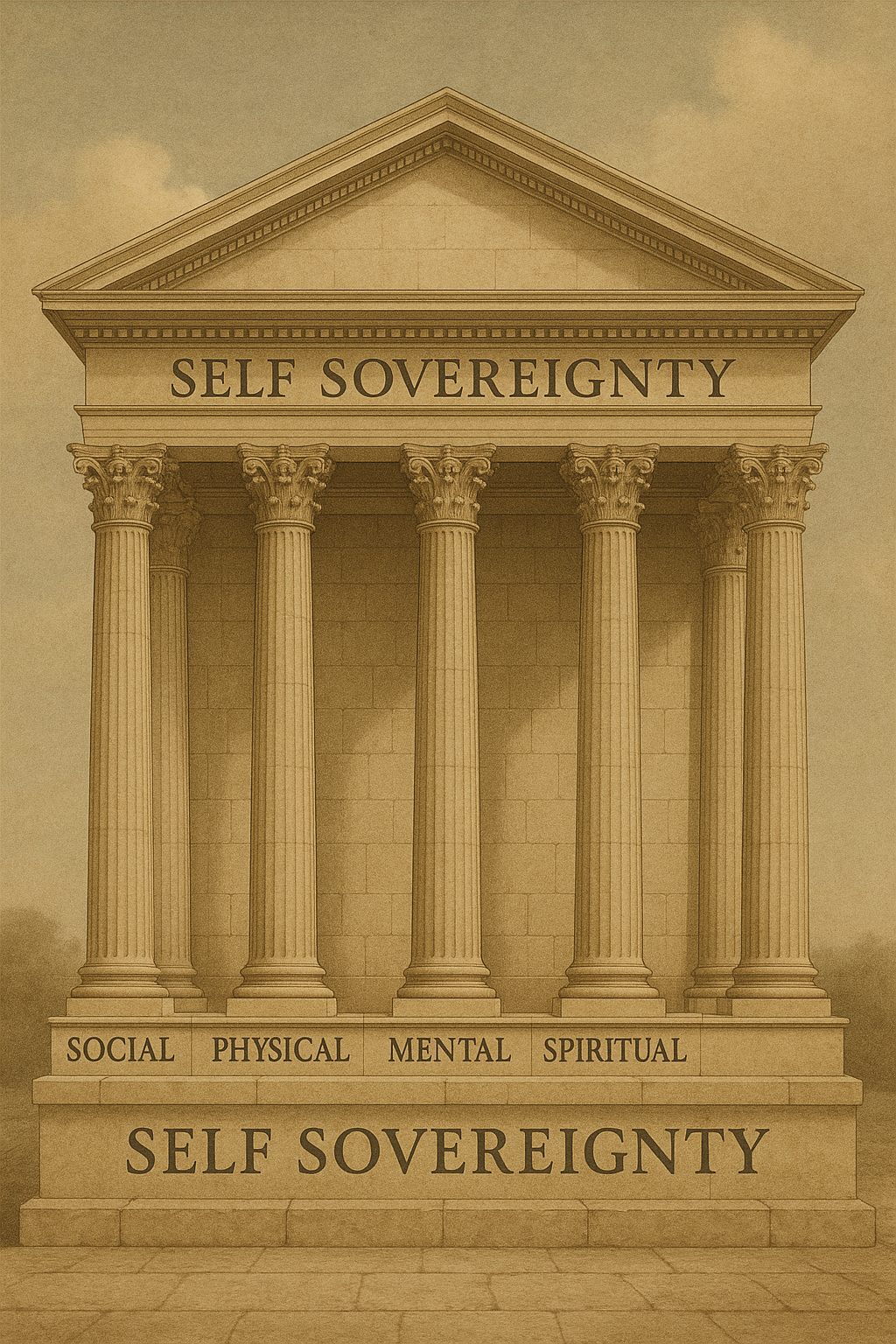
This first line of defense can be seen as various pillars one should develop and maintain in order to balance out the relevance they give to any one input. These pillars might be as follows: physical, mental/spiritual, philosophical, intellectual, social and romantic:
Physical
From time immemorial it’s been known that the only way to keep the mind healthy and capable of proper improvement and stability is through vicious exercise. There are only so many words I can use to describe the feeling I personally get after a leg workout, which is a good representation as it’s on the largest muscle. Something about deadlifting and lunges taxes the body in such a way that the mind rides a high for the rest of the day. Proper diet and macro (carbs, fat, protein) regulation are then equally important. Exercise equals hormonal balance.
Mental or spiritual
I interpret these as concerning our psychological and emotional state. This is best regulated by frequent journalling, meditating, and for me personally also kickboxing, though I don’t nearly do it as often as I’d like to. Writing down certain findings and reflections also works wonders in calming down the attitude towards a negative, and in case of a positive or an idea it helps marinate the idea further and usually results in even better outcomes. Next to journalling, meditation is the way to go I’ve found. Not sure about all the cult-like tendencies it has online, but for a person to practice in their own space with no outer influence or judgement, it does wonders in relaxing the mind from what’s usually a nonstop inner monologue. There’s this video somewhere online from Alan Watts about the need for silence in the brain. Most of us have gotten so used to having a non-stop inner monologue that we don’t even notice this, but, as I mentioned in ‘On Dynamic Thinking’ , there’s an important distinction between what is and what our brain makes of things. In the real world, ‘things’ just are. No judgement is part of their make-up such that things cannot exist without judgement. So why grant others’ judgment space in our sphere, and let it interact with the edges of our soul?
Philosophical
Read the works of the stoics. Epictetus, Seneca, Marcus Aurelius among them. Add a sprinkle of Ralph Waldo Emerson, Thoreau, Siddharta (Herman Hesse) and John Stuart Mill. Finally, add the cherry that are poems such as Invictus by William Ernest Henley, If by Rudyard Kipling, Man in the Arena by TR, and Horatius from the Lays of Ancient Rome.
Intellectual
Books and other valuable sources of information and knowledge keep a grounded perspective and backdrop to any incoming piece of information. They provide context, and a better ability for dynamic thinking. Often we find answers to the questions we have, and more importantly we get answers to questions we didn’t know we ought to have asked. Engaging our understanding of things is one of the best counters to any negative or extreme in the real world, for it detaches our nervous system from the constant push and pull of the world, and centers it around ideas and beliefs in ourselves.
Social
It is no denying that we humans need social interaction, it’s like a tank in our minds that depletes at a certain rate and every once in a while we must refill it. Obviously it’s very much possible to not drastically decrease this rate of depletion (look for instance at Dick Proenneke’s One Man’s Wilderness). However, for the average person, meaning one with a full time office job or studies where people with similar traits exist but we don’t necessarily interact with, this tank goes down quite quickly. It’s important to have informal acquaintances we interact with on a regular basis to refill our tanks. This allows us to contextualize other people’s poking of our being and not place unwarranted value to any one person’s attention to us.
Romantic
A pillar that’s unique for each of us but most important for a good relationship, both with our partner and ourselves.
In balancing and properly developing these pillars, I posit that our ability to filter input and regulate the quality of our output improves manyfold. A basis is formed for developing a meaningful life. I say this as it seems that when these pillars aren’t properly developed or maintained, we run into all sorts of trouble that keep us occupied on matters not worth our trouble. By balancing our attention between these pillars we have a base from which the great concept of compound interest is deployed.
Amendment 13/11/25: While running today I came to the realization that there might be an important concept interconnecting each of these pillars, namely ‘Self-Sovereignty’. The idea here is that each of us has full control over our lifes and choices, so that what really lies at the basis of being successful in each area of life is the ability to make good on our promises to ourselves, to not let ourselves down. Every time you wake up early, don’t let your mind degenerate into chaos and immediately get a 90 minute focus session in, not because you felt like it but because you planned this in advance and promised yourself, your base becomes a little more solid. This then goes for everything, it’s not about doing unpleasant things because we feel motivated, it’s about doing the things we promised ourselves we would do. It’s like a muscle that gets trained and carries the torch for all the pillars I’ve mentioned.
Meditating is just calming down our brains because we want it to calm down, both the choice to want this done and the subsequent execution help in the process of attaining a succesful result for this. Meditation for the sake of being someone who meditates yields nothing. Going through the day and choosing the mind’s level of turmoil and containing it in the appropriate fashion, however, has both promise and execution that if made good on, strenghten and make it easier the next time.
We can then extend this even further, and propose the notion that at the base of Self Sovereignty lies immersion, for the only way to truly commit to one’s fixed objective is to be truly there in the present. If we aren’t we might tell ourselves we did the workout, but subconsciously we know we cheated ourselves or could’ve done more. As such the ability to be truly present and be with a task in this instant forms a most important ingredient in our recipe of Self Preservation. To understand the spirit of what I’m referring to, I had my good friend GPT generate the following portrayal: