Senseo Prelude
This post is part of the Senseo series:
- Senseo Prelude
- Senseo Electricity Basics 1
- Senseo Electricity Basics 2: Generation
- Senseo Electricity Basics 3: Grid to Wall Socket
- Senseo Boiler: Heat and Electricity
- Senseo Boiler: Sensing Temperature
- Senseo Boiler: Sensing Temperature Part 2
- Senseo Boiler: Safety
- Senseo Boiler: Brewing
- What is Plastic?
- PCB - Printed Circuit Boards: Fundamentals 1
- PCB Fundamentals 2: MOSFET Transistors
- PCB Fundamentals 3: CMOS Logic
- PCB Fundamentals 4: Combinational v Sequential Logic
- PCB Fundamentals 5: D-Latch
- PCB Fundamentals 6: Clocks & Flip-Flops
- PCB Microcontroller Subsystems: CPU core
- PCB Microcontroller Subsystems: GPIO
- Senseo GPIO Button Example
- PCB Microcontroller Subsystems: ADC (Conceptual)
- Senseo Interlude: Considering Quality
- PCB Microcontroller Subsystems: RAM and FLASH memory
A thought exercise I’ve been engaging in since I was a little boy is that of the time machine game: what if I was teleported back in time some 500 years, or better 5000 years? What exactly would I be able to produce that the people of that period didn’t know how to produce themselves, what would be my competitive advantage and how exactly am I a master of my own time period?
This follows from a conversation I often have with myself: We often take for granted the devices we use on a daily basis, such as phones, laptops, coffee machines, refrigerators and so on. Which of those modern day devices do you know thoroughly enough to reproduce on your own, with nothing other than raw materials? Do you even know which raw materials you’d need in order to get started?
If you were truly teleported back in time and cannot produce a single thing the locals produce themselves, should you really take pride in the progress you claim our society is making? Are you a fundamental pillar of that society?
Obviously I realize it’s one thing to claim something, and another to generalize it, so do note that everything I write here is from my own perspective. I merely attempt to do inference based on a sample of one, my own exposure to the world. A sample of one is inherently biased and unrepresentative of the population, but bear with me.
Now I know I wouldn’t be able to produce anything worthwhile, and this kind of makes sense. In our current system of education, we’re taught from a young age how to reject our natural impulses in return for an occupation of study. This isn’t a critique, it’s a levelling of the playing field so that all children may conform to a similar form of study that gets them on track to get into higher education, which in turn has the goal of specializing them into someone that can adequately play their part in institutions or corporations. That’s the way a society functions, each person specializes in such a way they can contribute as best they can to the whole. This isn’t done out of altruism, but instead out of self interest. Specialization allows a person to compete, meaning to entice more demand for than there is supply of his labor, in turn getting him those perks he desires.
However, these perks aren’t enough for most people, which is why we all recognize the big sigh we let out when the working day ends. Having denounced the personal tendencies, or perhaps more accurately for most having prioritized those that provide immediate academic success at a young age, leaves us in a particularly vulnerably position at the level of ‘self’. You see, by not developing all the pillars of our person and consequently also both natural impulse generation and the skill to contain those, the self is left without shielding from the world. It instead has to rely on the impulses and discipline of the system, of society. This sounds perhaps quite vague but think of it like this, have you ever had trouble sitting still and focusing deeply for an hour on a personal project, anything personal? Yet on the other hand, doing the 8 hours of work that the typical professional working day requires, you do without a second thought, just like brushing your teeth. It’s something you do without thinking, you rely on the discipline of the system.
The problem is that this same system leaves the individual bare to the natural sways and impulses it has. Think for instance about the rising technological capabilities for which we can all see that a great deal of jobs will either change or be replaced. We’ve essentially forgone our own development and replaced it with a development that suits societal welfare, which is great for a lot of people, but on the whole it leaves everyone vulnerable. I don’t say this in an ideological manner, but merely infer that the lack of personal development makes it so that people must spend the majority of their days working a specific version of themselves, one that’s productive in a specialized sense and is built up by a lifetime of training. It is not for nothing that school doesn’t allow you to randomly sit in on a science classes if you’re studying an economics-language program, or universities don’t popularize interdisciplinary programs bridging business and hard science ~ at least here in Europe. So the majority of the day is spent living as person A, while the margins may be filled by person B. Yet for a lot of people, especially once children and a social life come into the picture, person B cannot really develop into an individual that can hold its own against person A, but merely becomes a supporting character.
This specialization that we’ve trained a lifetime to achieve has a specific downside, one that Adam Smith warned about very clearly when describing the invisible hand. The worker that is trained at performing singular tasks well can generally become so specialized that, when taken out of the environment of his specialization, he becomes worthless and ignorant. In simplistic terms, he who makes dials on the assembly line never learns how the clock itself functions. When he inevitably encounters someone and proudly tells of his profession in the watchmaking industry, he scarcely knows what makes the watch tick. Such is the nature of capitalism, which produces on the one hand a tremendous amount of welfare and innovation, and on the other imposes upon us certain threats that need handling on the individual level. Again, not a critique of capitalism, but a recognition of the cost of specialization. There are just certain personal consequences attached to any sort of societal system, and each individual must try to defend themselves as best as possible since the system as a whole has no incentive to do so.
“The man whose whole life is spent in performing a few simple operations, of which the effects too are, perhaps, always the same, or very nearly the same, has no occasion to exert his understanding, or to exercise his invention in finding out expedients [methods] for removing difficulties which never occur. He naturally loses, therefore, the habit of such exertion [efforts], and generally becomes as stupid and ignorant as it is possible for a human creature to become” (The Wealth of Nations, book V, p.840)
I think everyone subconsciously feels the vulnerability they’ve been left with coming from specialization. Here you are, having gone to school some 10-12 years and having gained such and such experience in a field about which your grandmother would say “Wow what wonderful achievements, you work so hard and you’re so smart”, yet you know that the success and perks you get are extremely dependent on the market not changing course or automation not making everything you’ve ever trained for obsolete. And how do you handle this when you have a mortgage eating a third of earnings coming from what you spend the majority of your time on, and children make you actually responsible for living creatures?
Another great book I read where this sentiment is echoed is ‘On Liberty’ by John Stuart Mill, who writes: “He who lets the world, or his own portion of it, choose his plan of life for him, has no need of any other faculty than the ape-like one of imitation. He who chooses his plan for himself, employs all his faculties. He must use observation to see, reasoning and judgment to foresee, activity to gather materials for decision, discrimination to decide, and when he has decided, firmness and self control to hold to his deliberate decision - Human nature is not a machine to be built after a model, and set to do exactly the work prescribed for it, but a tree, which requires to grow and develop itself on all sides, according to the tendency of the inward forces which make it a living thing”.
Only at the individual level are we able to battle those imposing forces, and despite the modern-day consensus that individuals bear little responsibility for the way their lives turn out, it remains the foremost necessity for each of us to become the captains of our ships and remain the masters of our souls. Naturally, this entails digging into the workings of all that is around us.
That’s what I intend to do here explicitly, but implicitly, as mentioned before, I intend to consciously build person B, and call it an identity anchor. One that is deployed daily, and whatever person A is supposed to experience in terms of volatility, that created by the tendencies and impulses of the system, I can push it to the back of my head and not worry about it for my person B is anchored to the present. The anchor is what protects me from the societal waves. It’s not about grand ideas or actions, it’s about doing something, anything, consistently for a small amount of time. That I may become more than the sum of my impulses (as Rust Cohle would say), for once the day is over and person B is expected back behind the wheel, the underdeveloped person can do no more than fill the time with static activities that give way to instant instead of delayed gratification.
The machine
Apart from those philosophical rationalizations I’ve alluded to, I recently got curious and took apart my Senseo machine to see what’s inside. It turns out there are several components that lay at the basis of making me a cup in the morning.
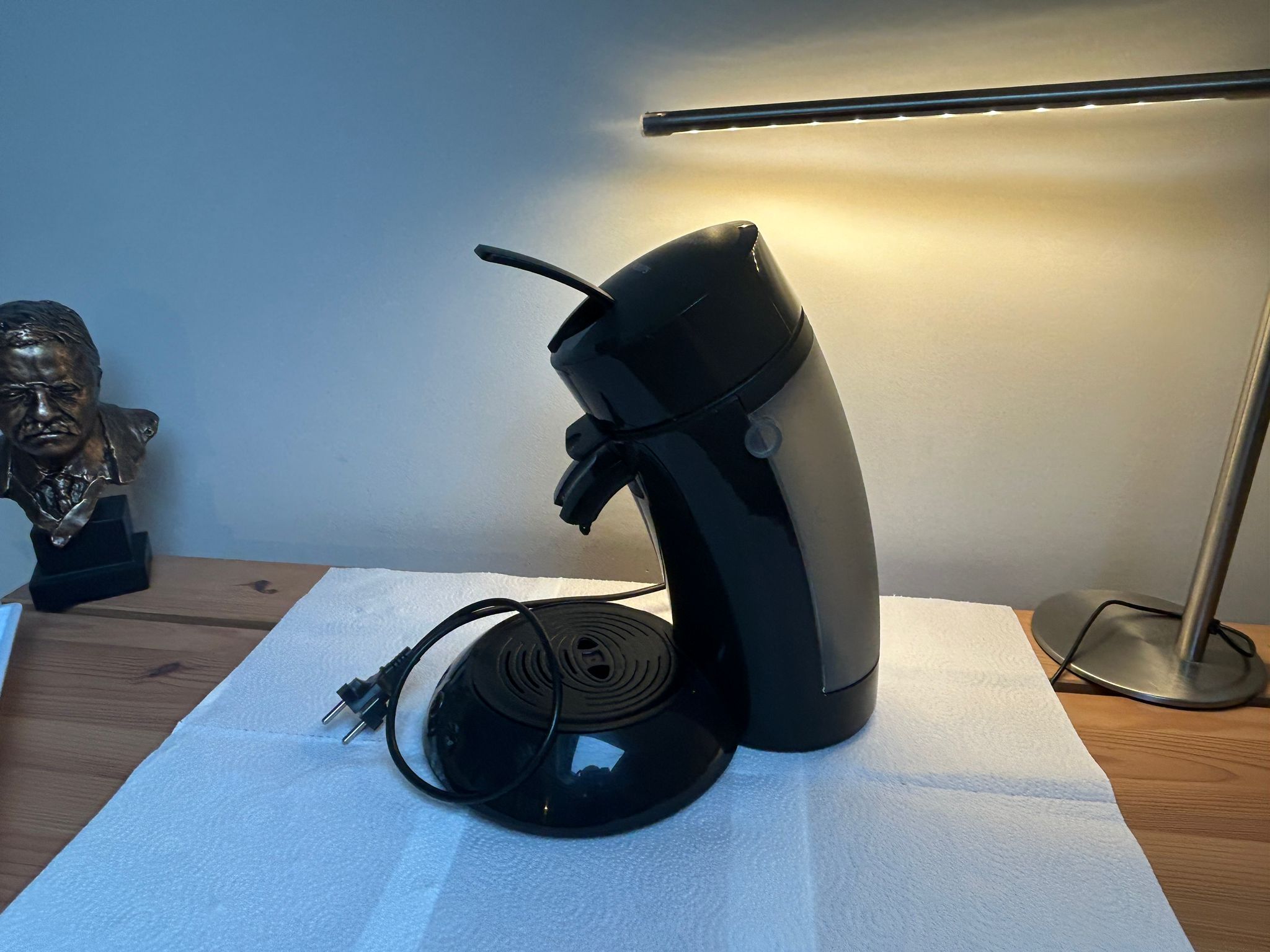
I’d say there are six essential components, namely electricity, a printing plate, a boiler, a pump, a valve system and extraction chemistry. We’ll start with electricity.