Senseo Boiler: Brewing
This post is part of the Senseo series:
- Senseo Prelude
- Senseo Electricity Basics 1
- Senseo Electricity Basics 2: Generation
- Senseo Electricity Basics 3: Grid to Wall Socket
- Senseo Boiler: Heat and Electricity
- Senseo Boiler: Sensing Temperature
- Senseo Boiler: Sensing Temperature Part 2
- Senseo Boiler: Safety
- Senseo Boiler: Brewing
- What is Plastic?
- PCB - Printed Circuit Boards: Fundamentals 1
- PCB Fundamentals 2: MOSFET Transistors
- PCB Fundamentals 3: CMOS Logic
- PCB Fundamentals 4: Combinational v Sequential Logic
- PCB Fundamentals 5: D-Latch
- PCB Fundamentals 6: Clocks & Flip-Flops
- PCB Microcontroller Subsystems: CPU core
- PCB Microcontroller Subsystems: GPIO
- Senseo GPIO Button Example
- PCB Microcontroller Subsystems: ADC (Conceptual)
- Senseo Interlude: Considering Quality
- PCB Microcontroller Subsystems: RAM and FLASH memory
Outlet Port Toward Brewing Chamber
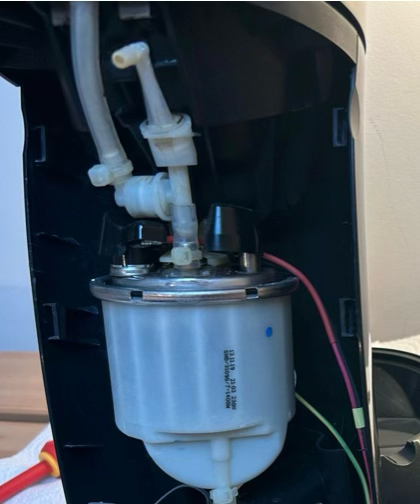
We then lastly also have the stub that looks like a chimney (Nr. 2) in the picture at the beginning of last post. This isn’t a chimney, however, it’s the hole where the water leaves the boiler when it is boiling. It may not be visible in that picture, but you can look straight into the boiler through that hole. In the first picture in the boiler series, you can actually see that this is where the tubes towards the upper chamber are attached to the boiler (see below).
My first instinct was to think the water must have entered the boiler at the top, and leave it at the bottom, but apparently it’s the other way around. We’ve seen that a body of water, such as in the boiler, is made of clusters of atoms (molecules), and in liquid water these molecules move around through that body of water. When the water is heated, additional energy is given to each molecule, making them jiggle faster and push against each other harder. As with the metal, this extra pushing leads to a higher average distance between molecules in the body of water, resulting in more space occupied (only a little though). Now some molecules will start jiggling so fast, they escape the liquid body and turn into steam (think of the states of water seen in school), becoming a gas molecule. These gas molecules move much faster and wildly than liquid molecules and take up much more space. If boiling occurs in a pot the gas form will just fly away, but in a completely closed boiler, these gas molecules can’t escape and will bounce into the walls very violently. Apparently, this slamming into the walls of the gas molecules happens millions of times per second, which is exactly what turns into pressure. As the water gets hotter inside, the slamming of the escaped molecules from the liquid (now gas) occurs more and faster, increasing pressure inside.
This pressure in turn pushes on everything inside the boiler, including the body of water. With only one escape for the water, the outlet port at the top will be the preferred choice. The pump at the bottom of the Senseo, in turn keeps on pushing water into the boiler, so a steady flow is created. What must be understood here is that the gas can already go into the vent and brewing system, but that brewing system is closed off, leading to a buildup of pressure. Despite this, the outlet vent is so small that pressure will still build due to the gas molecules not being able to leave fast.
Another misleading part is that the pump keeps pushing water in the boiler and the boiler might force water out regardless of pressure as a result. The two systems don’t work against each other, however, as the boiler is always full of water and doesn’t allow space for gas molecules except in tiny bubbles. As such heating makes the boiler like a pressurized pipe. So even though water is added at the bottom, the fact that the boiler is like a pressurized pipe leads to the same amount of water that entered through the bottom also leaving the top, but now with pressure pushing it fast (and hot given the heating). The boiler therefore never gets emptied, it remains full with tiny bubbles creating the pressure when heating.
The pump is actually the main driver of the water flow, but the pressure from the heat is what makes the water go fast. So pump is the driver of water flow, boiler is the heating and shaping of flow of the water.
Overview: when I make a cup of coffee, I press the on button, turning on the boiler. The boiler heats the water it has and pressurizes it, filling the vent chambers and brew head with hot water. No water flows until the coffee button is pressed. When this button is pressed (water going though pad into my cup) the pump is at last triggered, creating the actual flow of water that leads to water in my cup. The pump is the main brewing pressure (providing proportionally some 80% of the pressure).
The way the machine decides how much goes into my cup is then determined by the pump supplying a fixed volume of water. More on that in the pump section. The resulting idea of this brings us back to the Newton pendulum swing from the first electricity section. The pump pushes a fixed amount of water upward, and the same fixed amount (the heated part) on the other end is pushed out into my cup.
Now when we look at this close-up picture, the tube going upwards branches into two, one going to the brewing chamber, and the other being a vent tube. That vent tube serves a real purpose, but will be come back to in the valve system section.