What is Plastic?
This post is part of the Senseo series:
- Senseo Prelude
- Senseo Electricity Basics 1
- Senseo Electricity Basics 2: Generation
- Senseo Electricity Basics 3: Grid to Wall Socket
- Senseo Boiler: Heat and Electricity
- Senseo Boiler: Sensing Temperature
- Senseo Boiler: Sensing Temperature Part 2
- Senseo Boiler: Safety
- Senseo Boiler: Brewing
- What is Plastic?
- PCB - Printed Circuit Boards: Fundamentals 1
- PCB Fundamentals 2: MOSFET Transistors
- PCB Fundamentals 3: CMOS Logic
- PCB Fundamentals 4: Combinational v Sequential Logic
- PCB Fundamentals 5: D-Latch
- PCB Fundamentals 6: Clocks & Flip-Flops
- PCB Microcontroller Subsystems: CPU core
- PCB Microcontroller Subsystems: GPIO
- Senseo GPIO Button Example
- PCB Microcontroller Subsystems: ADC (Conceptual)
- Senseo Interlude: Considering Quality
- PCB Microcontroller Subsystems: RAM and FLASH memory
While writing on the PCB Senseo section, I went back to an old text I wrote exploring what sand is at its base, as it was relevant in the discussion on Fiberglass. Now the other important material for the PCB is Epoxy resin, which is a sort of hard plastic, and got me wondering what even plastic is. It’s a bit more complex than a little paragraph in the other post warrants, as proper understanding does claim some more time and exploration to develop. As such I write this separate post to have a good reference.
Leo Baekeland, a fellow Belgian, is actually the one who invented the first synthetic plastic. As with many of my recent posts, we’ll have to start from the ground up with atoms and molecules. When a group of atoms are together, we speak of a molecule. Every material is then made out of arrangements of molecules, such as wood, metal and water. Now when such molecules form long chains (like a rope or necklace), they’re called polymers (meaning ‘many parts’). Materials made out of such chains behave in a peculiar manner, they bend, squish and shape flexibly. That’s why these were called plastic, from the Greek plastikos (‘being able to be shaped’).
Before there was actual plastic, however, people used natural polymers such as rubber from rubber trees or shellac from insects. These were then very expensive and limited. This needs for something durable and cheap gave way to inventions, which is where Leo Baekeland came in. Leo was a chemist working on photo-graphics, having already invented the Velox photographic paper. Now in the early 1900’s with the advent of electricity and a need for light switches and insulators (protective casing to stop electrons flowing), materials being used most were wood and shellac. But wood burns and shellac was very expensive.
 Shellac, in fact, is the secretion coming from the lac insect. Just as humans produce sweat or earwax, this insect produces a sticky substance that hardens on tree (see picture). People would then scrape this casing of off the trees.
Baekeland wanted to find something that was cheaper, wouldn’t burn or conduct energy and could be molded into any shape. Chemists in that time period already knew that the mixing of the two molecules Formaldehyde (CH2O) and Phenol (C6H6O) resulted into an unpredictable sticky resin. The big problem was, it was impossible to control the outcome, sometimes it was hard and sometimes very liquid. What Baekeland then first built was a sort of pressure cooker, called the Bakelizer.
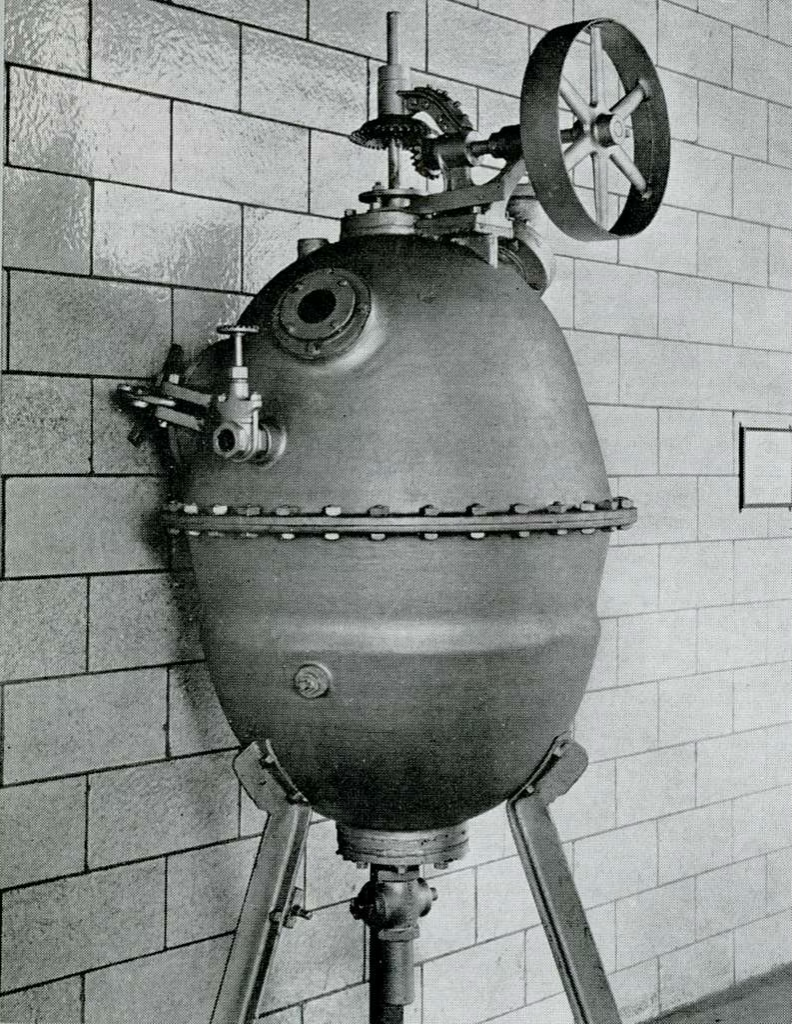 The idea was to control pressure and high heat , and by placing these elements inside and controlling the heating, they could be melted in just the right controlled setting. This Bakelizer relies on an external steam boiler, whose steam is transferred into the outer chamber and has the same effect as mentioned in the boiler section. In short, the gas form of water has molecules wanting to escape and be much more jiggly. When all brought together in a closed chamber the bump into the walls at millions of times a second and produce pressure. The process of water becoming steam also makes the gas molecules absorb lots of latent heat. When that steam then comes into the outer chamber of the cooker, it touches the cooler surface, gets condensed back into water and releases that stored heat into the metal. That’s how it was done before electricity: a boiler burning coal heats water, whose steam is transferred through pipes to a vessel. One such boiler could provide for many machines.
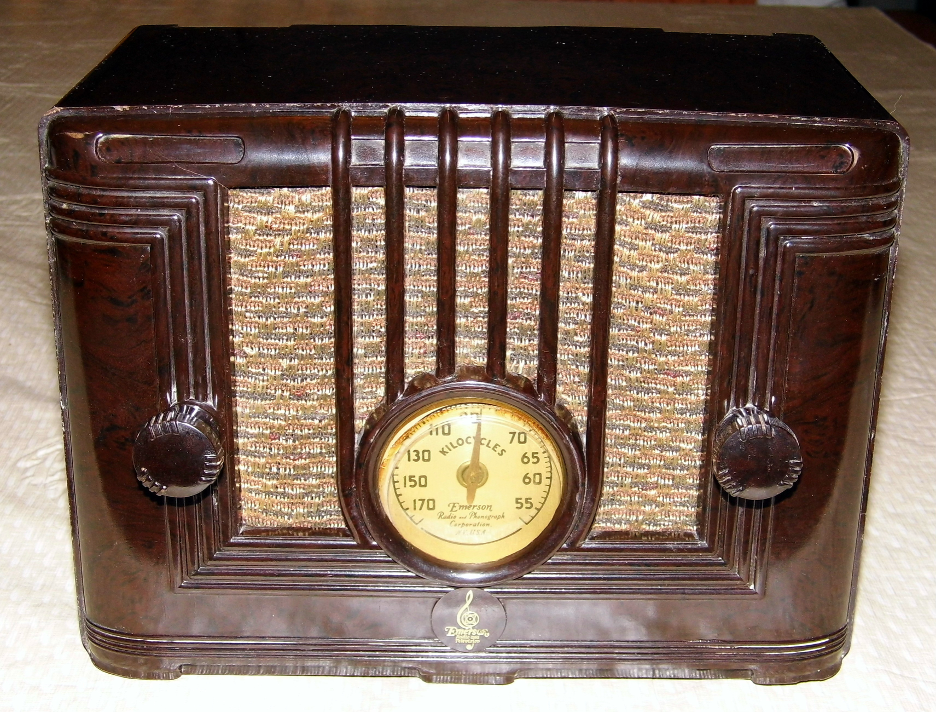
So when the steam comes into the outer chamber and condenses, it releases heat into the wall, and in turn heats the inner chamber. Now what Baekeland was able to do here is standardize the heating process for those two elements, and as a result created bakelite, which was the first synthetic plastic. This product was a hard, heat-resistant, moldable and electrically insulating. It was moldable in the sense that it could be poured into a mold and create shapes with it before it fully hardened. In essence, manufacturing was changed forever. One such application was the casing of this table radio depicted hereunder.