Senseo Electricity Basics 1
This post is part of the Senseo series:
- Senseo Prelude
- Senseo Electricity Basics 1
- Senseo Electricity Basics 2: Generation
- Senseo Electricity Basics 3: Grid to Wall Socket
- Senseo Boiler: Heat and Electricity
- Senseo Boiler: Sensing Temperature
- Senseo Boiler: Sensing Temperature Part 2
- Senseo Boiler: Safety
- Senseo Boiler: Brewing
- What is Plastic?
- PCB - Printed Circuit Boards: Fundamentals 1
- PCB Fundamentals 2: MOSFET Transistors
- PCB Fundamentals 3: CMOS Logic
- PCB Fundamentals 4: Combinational v Sequential Logic
- PCB Fundamentals 5: D-Latch
- PCB Fundamentals 6: Clocks & Flip-Flops
- PCB Microcontroller Subsystems: CPU core
- PCB Microcontroller Subsystems: GPIO
- Senseo GPIO Button Example
- PCB Microcontroller Subsystems: ADC (Conceptual)
- Senseo Interlude: Considering Quality
- PCB Microcontroller Subsystems: RAM and FLASH memory
Electricity is the most straightforward element, but essentially I could write a post on this topic in and of itself, purely for considering where it comes from and how to go from nothing to something.
Electrons
At its base, electricity is just moving electrons, which are negative electrically charged (as opposed to positive ones called protons) pieces of matter that are fundamental in the universe. These pieces of matter have likely existed since the big bang, and make up parts of the atom, which are the building blocks of everything around us, from hair, plastic, air all the way to our own human cells.
Small caveat here to one’s understanding: Given that electrical charge being positive dictates whether we have protons or electrons, and electrons themselves are only electricity when in a moving state, one might be confused by the naming of electric charge, which itself is only the fundamental property. The word ‘electricity’ was actually first coined in the 17th century as being the property of attracting small objects after being rubbed (by William Gilbert). The naming of ‘electric charge’, on the other hand, comes from Benjamin Franklin, who noticed that rubbing certain materials together would attract or repel (positive or negative charges). Only later did people discover the particles carrying it.
So electrons make up part of everything there is, and if they themselves are in a moving state, they form electricity, which can be harnessed to create currents that charge all kinds of phenomena, like light when going through a copper wire in my desk lamp. The magic in what was done a couple of centuries ago is that humans found out about this and became able to generate it using fire (combustion), water, wind, solar and so on. Not only did they find ways to generate it, they found ways to have non-stop generation be linked via metal wires to applications throughout the land. As a result, the house I’m sitting in is connected via wires to what is at the end an electricity generation station (or nowadays even solar on my own roof), which, through plugs in the wall and other means, allows applications we use to be put in motion as a result of the moving electrons.
Moreover, these moving electrons aren’t even moving that fast, only at a couple of millimeter per second, and can be visualized by one of those Newton cradle pendulums. A bunch of electrons sit on a metal wire, and when on the one end something is put in motion, it’s felt immediately on the other, at close to the speed of light. Think of pushing a light switch, which pushes the first electron near the switch and at the other end, the lamp, the push is felt and the bulb is on. When it comes to applications in the house, however, it’s managed in a slightly different manner. The power generation station somewhere in the vicinity is what’s pushing electrons (that are already there) into motion, and my house is managed in a big circuit, along which a bunch of small circuits are positioned. So when I turn on the switch in my room, what in fact happens is that the gate on the small circuit of lighting of my room gets closed, whereby electrons are put in motion in that circuit, and they are pushed through the circuit such that the application, my lightning, feels the current. So even on my desk lamp, when I press the switch, there is actually a wire from the plug coming and going through the lamp, so that this very little circuit is getting connected to the big circuit that is my house. As such, electrons are actually constantly on the tracks/circuits, but once the circuit becomes connected to the power station, they receive energy and start moving and the light bulb starts glowing.
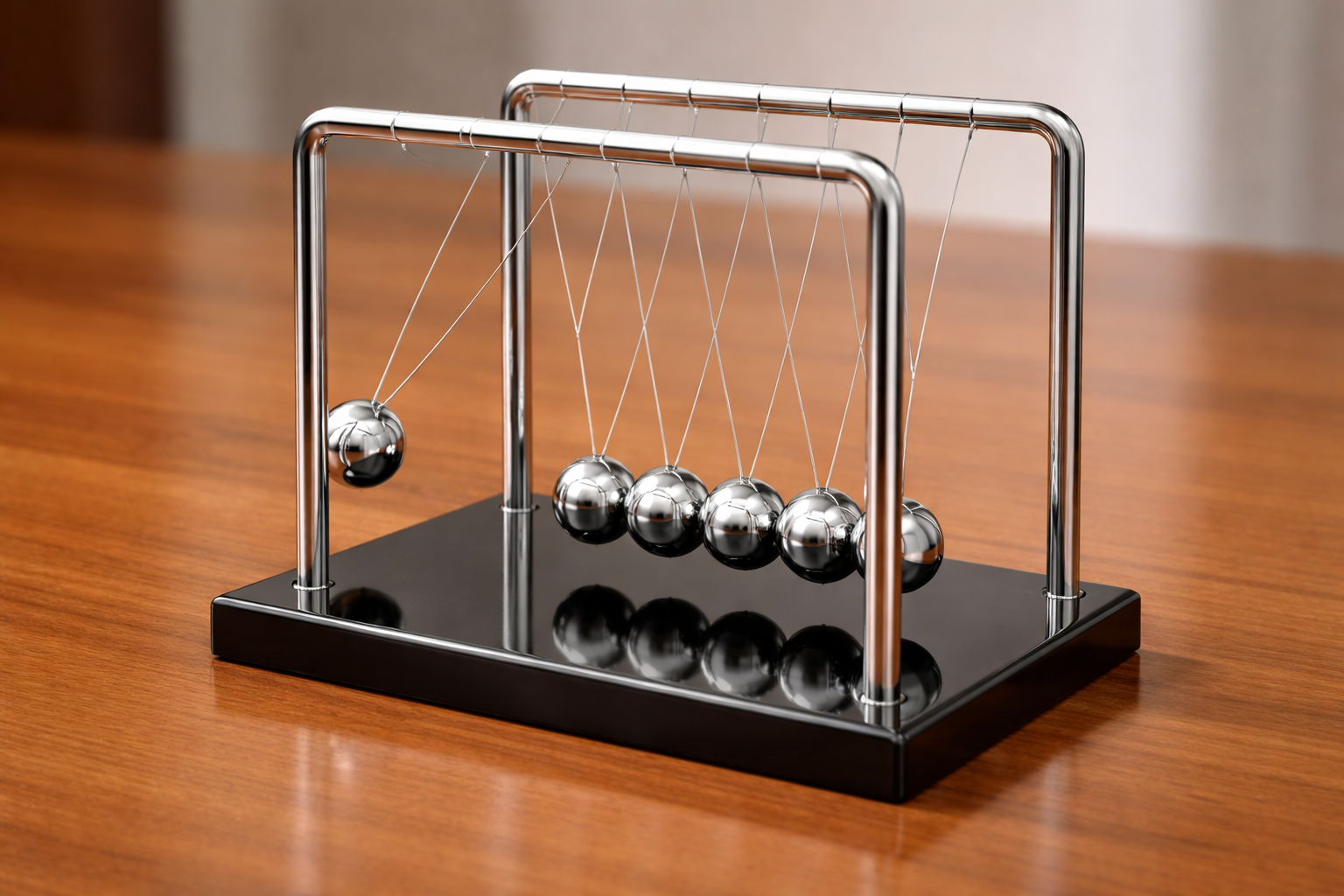
Essentially, there are two ways in which electrons can move: AC and DC. It is, however, important to first also stand still and define the basics.
Charge: can be seen as a property of matter dictating how it responds to electric and magnetic forces. This can be positive (proton) or negative (electron), where opposites pull towards each other and same charges push away. Unit of measure here is Coulomb.
Current: the rate at which electric charge runs through a conductor (material allowing flow of current), as measured in Amperes. If one coulomb of charge passes a point in the wire every second, the current is 1 ampere.
Electric field: the field around each particle with a charge, where each object around it will feel its presence. A nice example I found of this is combing hair: both hair and a comb are made of atoms, which contain electrons that move around a bit when materials rub together. Whenever I then actually move the comb through my hair, some electrons from my hair move onto my comb, so that the the comb therefore gains electrons (becomes negatively charged) and my hair gets positively charged. Now each charged object has a region around it where other charges try to pull or push. After combing, the comb has a negative electric field around it while my hair a positive electric field, and the comb for instance will pull pieces of paper. Note here that everything has an electric charge, but in normal conditions it has equally positive and negative charges and there is no net charge. Those objects that gain or lose electrons get a net charge (positive or negative). With hair, after having lost electrons and being positively charged, they all suddenly have this charge and therefore repel each other (same charges - like positives here - repel), this is what is called electrostatic repulsion. With the comb being able to attract paper, this is because the paper is neutrally charged (has both protons and electrons) but just has charges shift around inside, so when the comb with the negative electric field comes near it, it pushes the electrons slightly away so that the side of the paper closest to the comb is suddenly charged positive, and opposites attract so the paper moves towards the comb. Now remember that positive charges are protons and negative electrons, where protons cannot moves as they’re stuck in the nuclei of atoms, and electrons can move. That is why the neutrally charged paper suddenly has electrons move away a little whenever the negatively charged comb’s electric field comes near.
Magnetic field: has the same idea as the electric field but occurs only when charges are actually moving. Similarly, in the combing example, a magnetic field only occurs when there is the actual movement of combing, while before and after, when there is no rubbing the charges stay still, there’s just an electric field.
Voltage: is the difference in charge between two points. It tells us how badly charges want to move, so a high voltage signifies a strong push while a low one a gentle push. Measure here is Volt. If we can think of a water tank with a hose at the bottom, where the pressure on the water coming out is voltage, the amount in the tank is then charge. When we have a battery going low on our light and that light becomes dimmer, that’s decreasing voltage. For a very good tutorial.
Resistance: In the same example as for voltage, the hose width of the water tank signifies resistance, so that a narrow hose is more resistance and allows less charge to flow (so less current). A good conductor like copper has low resistance, an insulator like rubber has high resistance. Measured in Ohm (Ω).
Wattage: is the power, so how much (joule of) energy per second the electric system uses/delivers. It can be put in terms of current and voltage (P=V(voltage)*I(current)). Measure is Watt. High power tells us a lot of energy is being moved each second. This is what actually gets done (heat, light,…). At a household Voltage of 230V here in Belgium, my desk lamp of 7W is therefore designed to only draw enough current to equal 7W.
Okay now that we have all the basics of electricity listed, we can move to the two ways of describing a type of current in a circuit. DC or Direct Current (Edison) is a type of current flow where the electric charge only flows in 1 direction. AC or Alternating Current (Nikola Tesla) on the other hand is where electric charge changes direction every once in a while. AC is the type by which homes, offices and so on are wired, while DC is how all our appliances are wired. This isn’t by mistake, because AC has this reversal of charge flow, it also has voltage reversing along with the current. These features make it easy to send electricity over long distances quite cheaply. When the electricity leaves the power generation station, it does so at high voltage in order to make it moves efficiently (fast), meanwhile when it enters our home, a simple transformer is able to convert this high voltage into low voltage appropriate to our needs. Transformers unfortunately don’t work on DC currents (though this has changed in modern times and DC is increasingly also used to supply homes).
The generation of AC is then also amazingly interesting, as its process is mimicked throughout other processes (like that of the transformer). The generator has two essential parts, being a coil (spiral) of wire and a magnet, where the magnet usually spins very fast around that coil of wire. When this spinning occurs, the direction of the magnetic field passing through the coil continuously changes, and nature’s rule dictates that changing magnetic field pushes elections in a wire, so when the magnet is on one side, electrons get pushed, and when the magnet is on the other side, the electrons get pushed to the other side, making the electrons swing back and forth when spinning occurs. AC has a frequency of 50Hz/60Hz which tells us how many times per second the electrons switch direction (Europe 50, US 60). In short, a changing magnetic field is what creates voltage. The changing electric field is pushed outward along power lines at nearly the speed of light (see again the Newton cradle pendulum example above).
This transformer (wikipedia) is then just a simple component transferring the high voltage on the one circuit (wire coming to our home) into a lower (or just different) voltage on another circuit. It never directly handles the electrons, but simply shifts the voltage up or down, and mimics the generation of AC perfectly. It consists simply of two coils (spirals) of wire wrapped around the same metal core, so that when AC flows through the first coil, the changing current (that is inherent in AC) creates a changing magnetic field in the core, which induces voltage to the second coil. So the incoming AC electric field causes electrons in the transformer’s primary coil to oscillate (swing back and forth), which creates a magnetic field in the core of the transformer, which in turn induces voltage in the secondary coil. The voltage change is determined by the turns ratio (= Vout/Vin = (#turns on secondary coil)/(#turns on primary coil)). If 240 V enters, 24V will leave. In order to step up voltage, the secondary coil will have more turns than the primary, and vice versa. How much it steps up or down is determined by the number of loops of the coil around the core, for which we look to the turns ratio. As mentioned above, household frequencies generally have 50/60Hz, resulting in a quite small voltage per turn, for a typical transformer this means 0.2-0.3 volts per turn (exact one is also determined by size of transformer core), so that we know that the primary coil will need a certain amount of turns around the core (eg., 240V/0.24volts per turn = 1000 turns). From there we derive the number of turns the secondary needs.
With DC, it’s a little simpler and more aligned with how I explained electricity in the beginning. Electrons only flow in one direction, such as for a Senseo machine, a desk lamp or my phone. DC is preferred for these devices for many reasons, such as the fact that electronics store energy using capacitors (see next section), microchips need stable reference voltage, and desk lamps only produce light with current flowing in one direction. Interestingly enough, batteries generate DC from a mere chemical reaction inside of it.
Converting AC to DC
This process, of electricity from outside my house (AC) coming in adapted so it’s usable for my devices (DC), consists of various quite important steps:
Transformer: As already understood, these merely step up or down the voltage, keeping the charge type AC.
Rectifier: is and electronic device converting AC to DC (rectification = straightening). The idea is that if we can allow current to go one way but block it from going the other (AC), we can use such a one way valve for electrons. This is what a diode is. Four of these diodes are arranged in such a way that they form a bridge rectifier that keeps on pushing the elections forward. So even if AC tries to push them backwards, the bridge rectifier flips them forward again. As such we get constant forward bumps that still need smoothing. The bridge rectifier essentially arranges four such diodes in a square shape, so that one diagonal pair lets current through and the other blocks it, creating pulsating DC.
This diode is in fact quite impressive physics at work. It is made of two types of silicon being pressed together, an N-type and a P-type, where the N-type has extra electron (more negatives) and the P-type has a lack of electrons. Silicon in itself is balanced in terms of electrons, but by adding phosphorus, extra electrons are added (N-type) while by adding boron, there’s the effect of spots having missing electrons (P-type). These properties are therefore built into the material when the diode is made.So when they touch, the electrons and the holes meet and cancel out, forming a barrier region. Now if we try to push electrons from N to P, we reduce the barrier so that electrons can move and the current flows. However, if we’d like to go the other direction, that same barrier will behave very differently, and the push will increase the barrier, making it difficult to cross.
Capacitor: is a device that can store electric charge and is used to smooth out that bumpy flow. The idea is that whenever there is a rise in electrical current, the capacitor fills with charge, while whenever it fills, the capacitor releases the stored charge. So holding and releasing the charge allows the gaps between these forward bumps (created by the rectifier) to be filled, smoothing out the current. It essentially stores charge and slowly releases it again, mitigating the pulses of the capacitor. It consists of two metal plates and a very thin insulator, where the plates can hold opposite charges and the closer the plates the bigger the area so the more charge can be stored.
Voltage regulator: since many devices require a very precise amount of voltage, the regulator adjusts this so that it stays constant. This can be important whenever we change environment, have fluctuation wall voltage or the device needs more power. Such regulators use feedback in order to measure the output voltage, compare it with the desired voltage and then continuously adjust until they match. For a simple circuit like a lamp it will use a linear regulator to just gently resist excess voltage, while for a laptop a switching regulator is used where it can rapidly turn currents on or off and hence average it using for instance a capacitor.